Inclusive Practices in Integrated Curricula

Before the end of the school year, this researcher conducted an action research study to investigate the inclusion of multimodal and culturally responsive practices to improve student engagement and academic growth.
Too often, students from different races and ethnicities are challenged to participate in learning environments that have been designed for classes with predominantly white students. As a result, culturally diverse students are assigned to remedial education classes, special education classes, and, unfortunately, alternative education spaces for not achieving and behaving in ways familiar to their teachers.
Multimodal strategies that promoted not only audio and visual learning but also kinesthetic movement emerged in the late 20th century. Dewey (2021) stated that these interactive approaches to learning encouraged creativity and choice. Culturally responsive practices were introduced by Ladson-Billings (1995) as a means of improving education and increasing equity by teaching educators to be culturally responsive in their work with marginalized students.
Make It Personal
Cast (2025) stated that an integrated curriculum should include clear goals that provide learners with multiple ways to achieve them. Students should also have equal access to an engaging learning environment and to materials that support achievement of learning objectives. Lastly, teachers should strive to make learning personally relevant for all students, not just the majority or the familiar. Students need to feel connected to what they are learning. They need to feel that they can trust their teachers and that they are a part of the learning community. Incorporating multimodal and culturally responsive practices into curricula and lesson plans is a way for teachers to set the stage for how they want their students to feel in class and the achievement they hope all students will meet.
Do The Inside-out Work
Cultural responsiveness is a way for teachers to build relationships and engage with students from day one. This, however, requires teachers to reform their pedagogy and practice. Hammond (2015) stated that teachers need to reflect upon their pedagogy and practice and come to terms with their preferences, biases, and day-to-day interactions with students of different races and cultures. Myers (2024) highlighted the fact that different
pedagogical approaches need to be incorporated into curricula to address students' unique qualities. Educators need to be more reflective if they want to identify the areas within themselves that need to change to bring about changes in how teaching and learning occur in their classrooms.
Teacher reeducation that targets CRP practices such as “visual aids, whole group accommodations, modifications, cooperative learning, peer tutoring, instructional scaffolding, social skill instruction, active/applied learning and alternative assessements (O’Keefee & Medina, 2016)” and MMP such as Visual Thinking Strategies and Talking Drawing (Barton, 2023) not only will reduce barriers to learning but also create a safe and active learning environment where all students will feel comfortable whether succeeding or failing at learning.
Lesson Plan Development Strategies
Ensuring that the needs of diverse learners are addressed should be evident in every lesson plan. It should not be an aside added as something that could be done if time were permitting. Hayes and Bulat (2017) stated that inclusive education is effective for engaging all students in learning. Cailyn et al.(2020) stated that personalized learning experiences are created when students are provided with options. Hammond (2015) reminds us that community, conversation, and collaboration are traditional practices in many culturally diverse communities, whereas individuality is a common practice in the United States. Collaborative groups and choice are two culturally responsive practices among many that work to engage diverse student groups.
Technology
Technology offers a variety of tools to serve a diverse student population. If used correctly, technology does more good than harm, offering linguistically and culturally diverse students options to hear full-text read to them or to speak and see their words come to life on the computer screen. Having these options written into the lesson plan creates fluidity and community as students begin to see how intentionally their teachers include practices that promote positive learning experiences.
Teacher Perceptions:
Likert Scale Results:
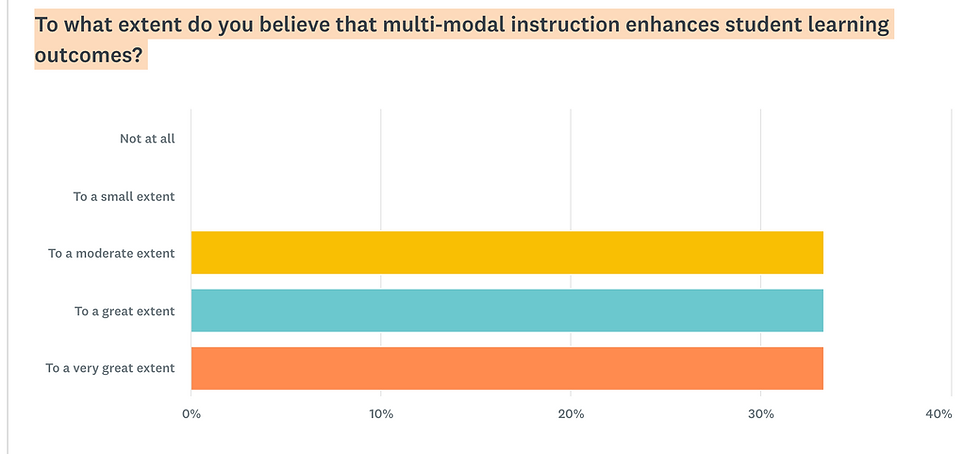
The Likert-scale results from three teachers revealed varied views on multimodal strategies. Two teachers taught in public, Title I schools, and one taught in a suburban private school.
One of the two public school teachers stated she researched multimodal strategies before answering questions. She stated that, as a dyslexia specialist, she used multimodal practices, including audio, visual, and kinesthetic modalities. She highlighted the hand gestures and movements she used with her students to help them connect to learning targets. The word "multimodal" did not exist until she looked up the terminology.
Regarding enhancing student outcomes, more teachers would need to take the survey, as the three who did were split between outcomes being greatly enhanced and moderately enhanced. The terminology should also be used more in curricula, lesson plans, and professional learning, so that understanding and confidence in usage become more natural.
Interview Results:
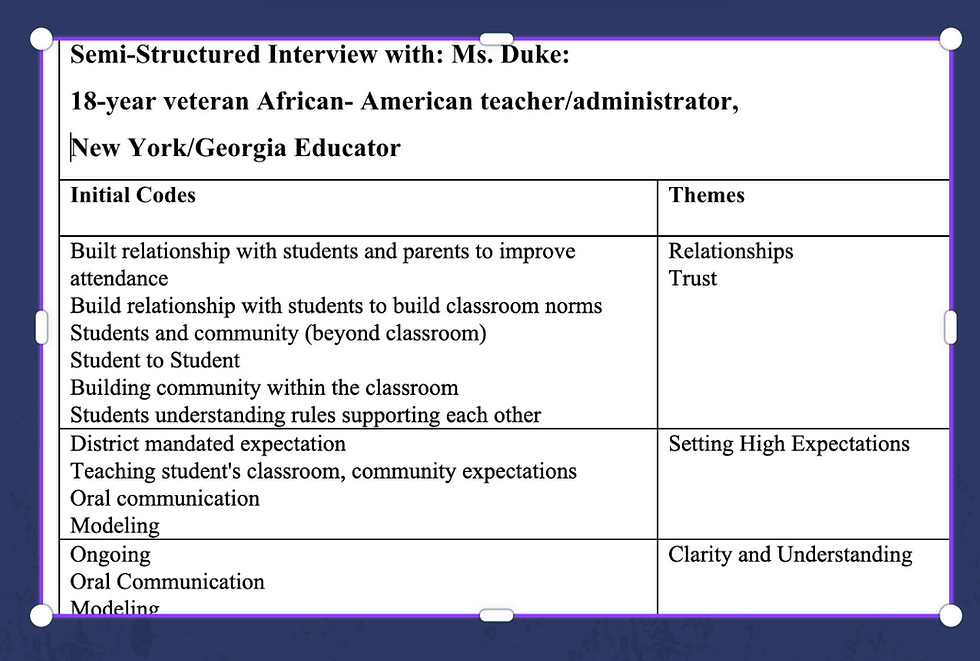
One 18-year veteran educator was interviewed. To encourage diversity, empathy, and respect, this teacher highlighted trust, modeling, community, and experiences. She stated that once trust was established, students formed a community that supported one another. She stated that field trips helped students connect to their community and to what they were learning. Building relationships with parents helped create common academic and behavioral goals that students learned to abide by. She also "appreciated" student-centered learning but highlighted the importance of students understanding the need to respect the "house" of the teacher. She did not agree with rigid rules but stated that students should respect
Getting first-hand information from teachers provided insight into how their core beliefs create inclusive spaces and learning opportunities for students. The teachers interviewed were all black educators with 12 or more years of experience. Although culturally responsive and multimodal practices were not explicitly stated, some of their responses indicated an understanding of the need for both.
The terms and expectations are often not stated and should be incorporated into the curricula for all educators. For educators who are opposed, there should be ongoing support, including mindset training to help them better see themselves and clearly recognize the diversity of learning needs entering their classrooms each day. According to Brown (2017), educators must work intentionally to get to know their students and engage them so students can develop the skills and practices that will help them reach academic benchmarks.

References
Barton, R. (2023). Beyond the lable: Multimodal strategies for working with multilingual learners. Montana English Journal , 44(0), 1–8.
Barton, R. (2023). Beyond the lable: Multimodal strategies for working with multilingual learners. Montana English Journal , 44(0), 1–8.
Dewey, J. (2024). Multimodality | research starters | EBSCO research. EBSCO. https://www.ebsco.com/research-starters/social-sciences-and-humanities/multimodality#full-article
Ladson-Billings, G. (1995). Toward a theory of culturally relevant pedagogy. American Educational Research Journal, 32(3), 465–491. https://doi.org/10.2307/1163320
Lim, W. M. (2024). What is qualitative research? An overview and guidelines. Australasian Marketing Journal (AMJ), 33(2), 199–229. Sage Journals. https://doi.org/10.1177/14413582241264619
O’Keeffe, S. B., & Medina, C. M. (2016). Nine Strategies for Helping Middle School Students Weather the Perfect Storm of Disability, Diversity, and Adolescence. American Secondary Education, 44(3), 72–87. http://www.jstor.org/stable/45147888
Saugadi Saugadi, Mustakim Mustakim, & Bebbouchi, D. (2024). The role of peer mentoring in reducing dropout rates and strengthening social support networks in universities. Educational Dynamics International Journal of Education and Social Sciences, 1(4), 41–50. https://doi.org/10.70062/educationaldynamics.v1i4.273
Verhoef, M. J., & Casebeer, A. L. (1997). Broadening horizons: Integrating quantitative and qualitative research. The Canadian Journal of Infectious Diseases, 8(2), 65–66. https://doi.org/10.1155/1997/349145
Comments